The Rise of Robots in Everyday Life

When most people think of robots, their minds jump to Transformers or Westworld — shiny metal beings that move, think, and banter like humans. That’s still mostly movie magic, but the gap is closing fast. Across the world — and especially across Southeast Asia — robots are shifting from sci-fi spectacle to everyday infrastructure. The global robot market size reached US$50.4 billion in 2025, projected to grow at a 5.2% annual rate and reach approximately US$65 billion by 2030.
And automation is infiltrating the tiny, mundane moments: a robot gliding across a mall at midnight to clean, a machine delivering your bubble tea, a robot sentry patrolling the entryway of a mall. One day you don’t notice them, and the next you suddenly realise: they’re everywhere now. And people are getting used to it surprisingly fast because these robots show up as helpers, not invaders, quietly taking on the dull tasks that nobody really wants to do anyway.
This momentum is supercharged by funding — a surge of global capital pushing robotics forward and turning experimental ideas into real-world deployments faster than before.
Why is robotics suddenly a funding supernova?
Short answer: the world finally needs robots — and robots are finally ready.
Long answer: The global labour crunch is now structural. F&B operators can’t hire fast enough. Hospitals are short-staffed. Warehouses overflow. Manufacturing churn is relentless. Humans aren’t just tired — they’re scarce and expensive, and in the developed world, picky about what jobs they undertake.
Meanwhile, the cost of building robots has fallen meaningfully. The average cost of industrial robots worldwide dropped from about US$46,000 in 2010 to US$27,000 in 2017, and recent forecasts suggest it could decline further to around US$10,800 by 2025. Sensors, chips, batteries, connectivity, and AI have all matured and become significantly cheaper, making mass production far more achievable than it was a decade ago. Robot production costs are also projected to continue decreasing over the next five years.
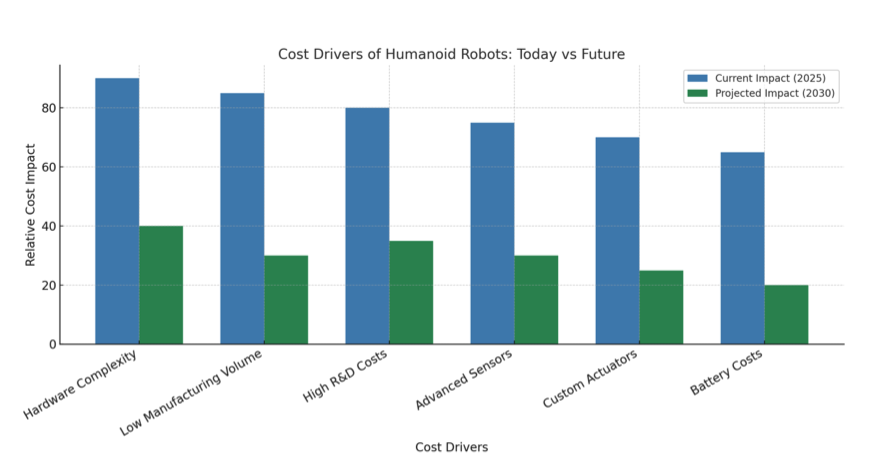
The cost of robotics is expected to halve in the coming years
And then there’s the mindset shift. Robotics is no longer seen as a moonshot. It’s a budget line. Operators aren’t asking if robots will work; they’re asking which robots, how fast they can be deployed, and at what ROI.
Investors see the demand. Operators feel the pressure. Consumers are unfazed. It’s the perfect storm — and it explains why robotics is having its moment.
Three types of robots on the market
Service & Delivery bots: The first wave of automation
Visit Changi Airport and you’ll find a glimpse of the future — except it already feels ordinary. Cleaning robots glide through terminals. Plate-collecting bots roam food courts. Traffic-control bots politely warn idle drivers. A robot barista might hand you a latte crafted with perfect microfoam. They smile on-screen, they beep politely, and almost no one pauses to stare.
Meet Liang Liang, the robot cleaner helping keep Changi Airport spotless
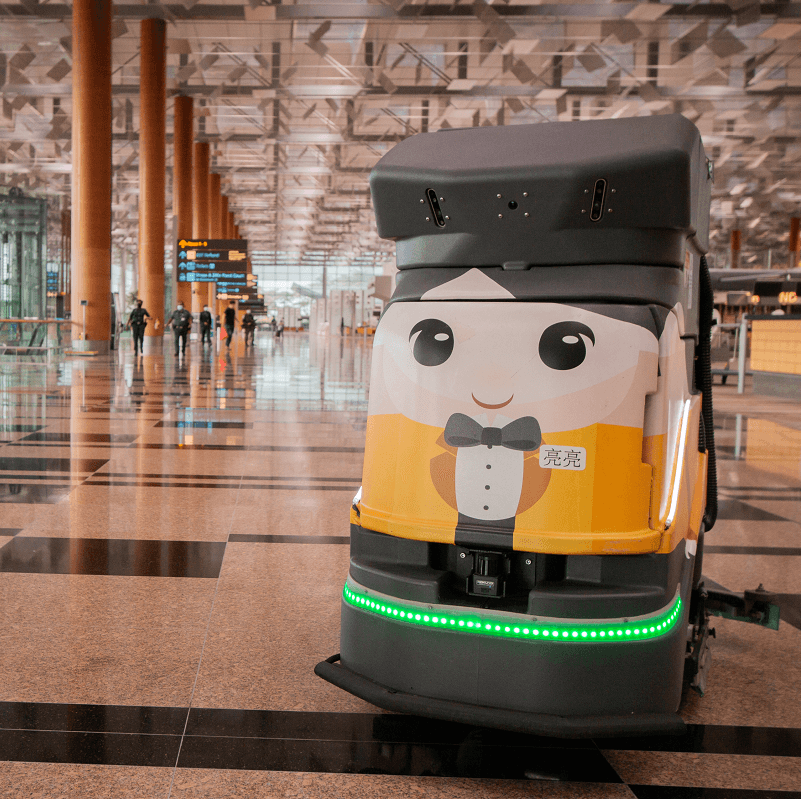
These are service and delivery bots: simple, single-task machines that run semi-autonomously and reliably, like robotic interns who always follow instructions and never get bored. And across commercial spaces, the economics behind them are becoming impossible to ignore. Many models cost around US$1,000 per month to rent, far below the cost of hiring cleaners, runners, or security assistants — roles that are increasingly hard to fill in developed, urbanised markets.
As cities expand and younger workers steer away from physically demanding, low-paid jobs, these bots step in to take on the work few want to do. For hotels, malls, and airports, the math is straightforward: a predictable monthly lease replaces multiple shifts, eliminates turnover headaches, and provides reliable 24/7 coverage. In tightening labour markets, these robots aren’t just useful — they’re economically necessary.
And inside homes, the shift is just as visible. Take robot vacuums: once a novelty item, many now cost US$100–500, cheaper than hiring part-time cleaners in most major cities. In Vietnam alone, Ecovacs expects robot vacuum sales to surge 80% to nearly US$10M in 2025. As cities get denser and lifestyles busier, these “functional roommates” are becoming standard household infrastructure, quietly taking over the chores no one has time — or desire — to do.
Fully unmanned solutions: The specialist robots
If service bots are interns, fully unmanned robots are specialists — machines trusted to take on whole workflows without supervision. These robots handle tasks end-to-end: cooking, sorting, prepping, or moving goods with zero human involvement. They don’t assist; they replace the entire workflow.
Globally, interest is intensifying. DYNA recently raised US$120M in its Series A just months after its previous round, deploying robots that fold laundry, sort objects, and prep materials, and can learn and adapt in new environments. In the UK, Moley Robotics showcases a dual-arm kitchen robot capable of stirring, chopping, plating, and executing more than 5,000 recipes with chef-level precision. From Germany, Circus SE and GoodBytz stand out as pioneers of the fully unmanned robot kitchen, running autonomous cooking systems that deliver high-quality meals at scale without the need for specialist kitchen staff.
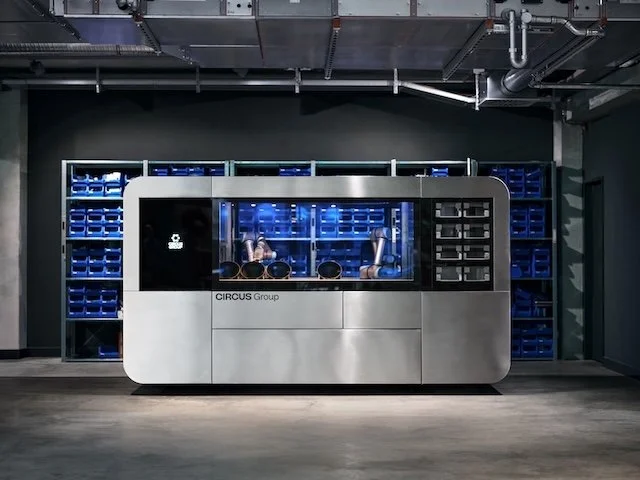
Circus Group’s CA-1: an AI-powered autonomous robotic kitchen platform
With rising labour costs and shrinking urban spaces, compact robots that work nonstop aren’t just appealing — they’re becoming the financially obvious choice. Take F&B as an example, a full-time chef in Southeast Asian big cities can cost US$1,000–3,500 a month, while head chefs often reach US$4,000–6,000, before adding training, turnover, or overtime. Meanwhile, prime urban rentals in Singapore, Ho Chi Minh City, or Bangkok can climb to US$3,000–5,000 a month, locked into long leases and renovation costs that turn underperforming outlets into expensive mistakes.
Autonomous kitchen systems offer a cleaner equation. Renting the unit can range between US$1,500–4,000 per month under Robotics-as-a-Services (RaaS). And unlike traditional restaurants locked into long leases and costly renovations, robotic kitchens are easy to deploy, easy to relocate, and come without the painful sunk costs that keep operators tied to underperforming locations. Robots also deliver consistent, identical output — exact temperatures, precise portions, and no variance between a slow weekday lunch and a bustling weekend dinner. It’s a level of predictability human teams, no matter how skilled, struggle to maintain.
Put together, the math is hard to ignore. Lower operating costs, perfect consistency, and the ability to “lift and shift” equipment without financial penalties are why unmanned automation is shifting from a futuristic upgrade to a survival strategy in F&B, logistics, manufacturing, and retail. Studies are estimating that automation could drive more than 22% in labour cost savings in the U.S. by 2025, underscoring how significant the efficiency gains can be. These robots don’t take breaks, call in sick, or quit mid-shift. They’re not replacing humans — they’re replacing the chaos of constant hiring, inconsistent quality, and unpredictable operations.
Humanoid robots: The next wave of the workforce
And then there are the humanoid robots, the kind that once lived only in sci-fi films and Elon Musk keynotes. These robots mimic human form and movement, allowing them to operate in human-designed environments. They walk, grasp, lift, carry, wash your dishes, and fold the laundry you keep ignoring, can quickly pick up skills and essentially do any task a human can do.
Figure AI is building humanoids designed for general household and service tasks, with its upcoming Figure 03 model targeting an aggressive retail price of under US$20,000 at high production volumes. Tesla’s Optimus is learning to walk more fluidly, fold laundry, handle objects, and perform repetitive labour, and early estimates put its future price in the US$20,000–30,000 range once scaled. Meanwhile, emerging players like NEO are focused on consumer-friendly humanoids for retail, hospitality, and home settings. NEO is already taking pre-orders at US$20,000 for Early Access units, or via a subscription at US$499 per month. Aria from Realbotix, developed for companionship and interactive engagement in both personal and corporate settings, starts at around US$95,000.

Not man versus machine but man with machine
We’re still early — humanoids wobble, gesture awkwardly, and often behave like toddlers learning to walk — but the trajectory is unmistakable. As capabilities improve, production costs fall, and robots become more natural and expressive, we’ll see far more humanoids across care, service, and everyday environments.
Where is Southeast Asia in the robot race?
Southeast Asia’s young, digital-native population, rising labour costs, shortages across labour-intensive sectors, and a cultural openness to new technology make the region one of the world’s most fertile grounds for robotic adoption. And we’re already seeing it unfold across all three categories.
In service and delivery robotics, it’s becoming increasingly common to spot robot arms working behind the counters of big-city cafés. Singapore’s Ella by Crown Digital can deliver up to 200 café-quality drinks per hour. Over in public spaces, Singapore’s LionsBot cleaning robots roam malls and office towers as naturally as security guards and cleaners once did. And in Thailand, Pharmathek’s automated medicine-dispensing robot has begun appearing in a major hospital, streamlining prescription distribution and cutting waiting times.
On the unmanned side, cooking robots are rising fast. Rolo Robotics is building autonomous micro-kitchens capable of producing full meals 24/7, expanding into Asian cuisines to match Southeast Asian tastes. And even humanoids are finding their place. VinMotion’s dancing humanoids draw crowds in Vietnamese malls, while Dex-Lab’s Dexie supports seniors in Singapore’s community centres, or Mornine - a charming humanoid robot deployed as “Intelligent Sales Consultant” in an automotive showroom in Kuala Lumpur, transforming what once felt like sci-fi spectacle into a friendly part of everyday life.
The future of food will be built by robots
What’s Next: The Path to Seamless, Scaled Robotics
The next decade will be about robots blending so naturally into daily life. Scaling robotics means making them feel like appliances, not engineering projects — simple to install, simple to maintain, and able to work with other systems instead of living in closed silos.
Business models will shift, too. Robotics-as-a-Service will turn machines into predictable operating expenses, not giant capital purchases — aligning incentives so robots only succeed when their customers do.
And as those pieces fall into place, robots will shift from novelties to necessities — quietly redefining how the region works, serves, and lives every single day.
Related Posts
SEE ALL
12 Oct 2026

01 Dec 2025

22 Jul 2025

14 May 2025

20 Feb 2025

01 Jul 2024